4D CT-based long perfusion

Background

Pulmonary perfusion is used to describe the magnitude of blood flow within the lungs and its spatial distribution. During inspiration, oxygen from inhaled air is stored in tiny alveoli. Meanwhile, blood pumped by the heart flows through the capillaries surrounding these alveoli, enabling efficient gas exchange. Proper oxygenation of the body relies on adequate matching between ventilation and perfusion. Assessment of pulmonary arterial perfusion is of great importance for the diagnosis and functional evaluation of lung diseases such as pulmonary embolism, chronic obstructive pulmonary disease (COPD), and pulmonary arterial hypertension.

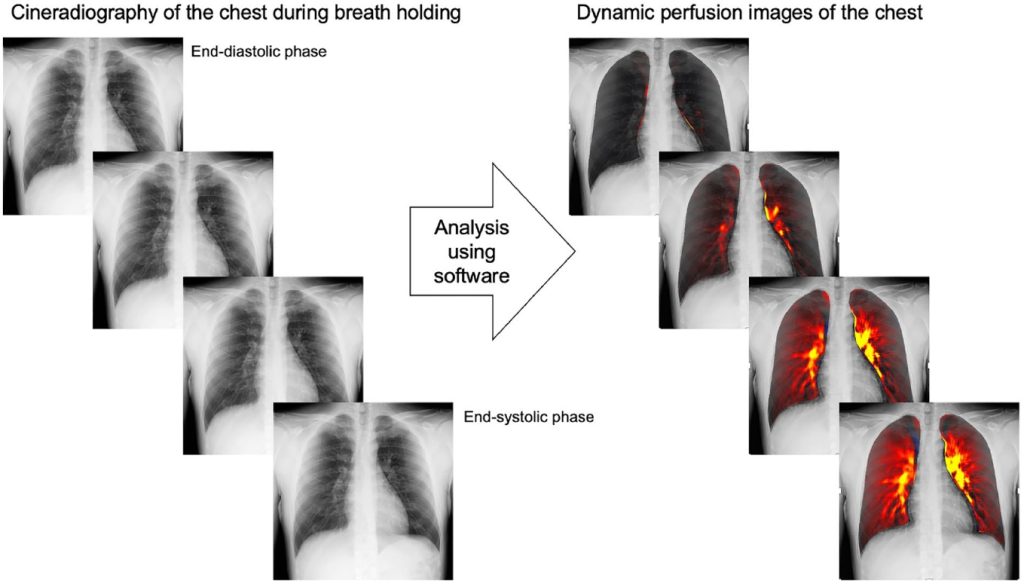
Fig. 1.  Dynamic perfusion images of the chest created from cineradiography of the chest while holding breath. Yamasaki et al. (2024) 

Existing Methods

The most commonly used clinical imaging techniques for evaluating pulmonary perfusion include computed tomography pulmonary angiography (CTPA) and radionuclide ventilation/perfusion (V/Q) scintigraphy. Both methods depend on exogenous contrast agents or radioactive tracers, and therefore have limitations such as the need for iodinated contrast injection (with potential allergic reactions), procedural complexity, and relatively low spatial resolution.

Pulmonary Perfusion based on 4D-CT

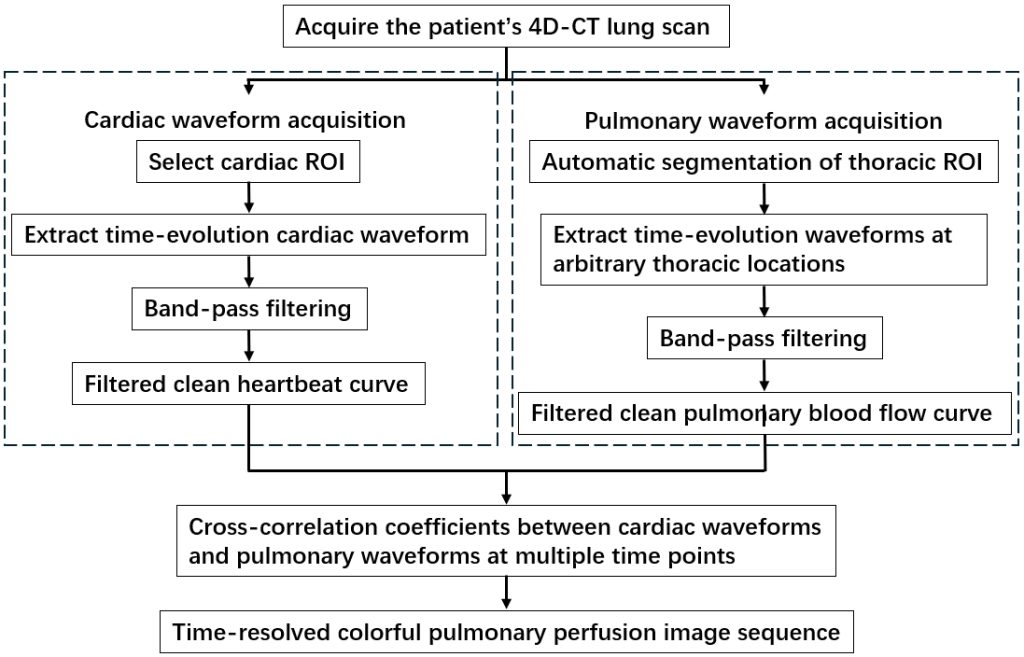
4D-CT–based pulmonary perfusion visualization can be achieved without additional hardware or changes to the examination workflow. By extracting reference waveforms from the heart and pulmonary vessels and performing cross-correlation analysis, it generates time-resolved color-overlaid image sequences, thereby providing an intuitive visualization of the propagation characteristics of pulmonary perfusion.

Fig. 2. The workflow of the 4D-CT-based pulmonary perfusion visualization method.

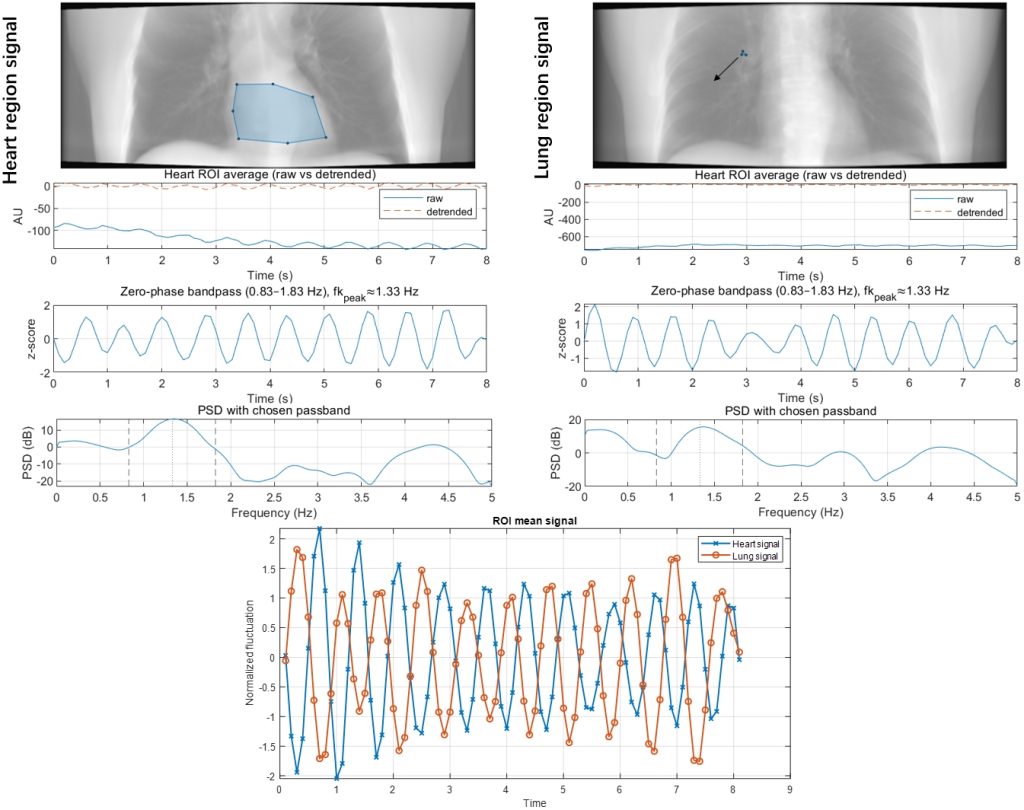
Fig. 3. A schematic illustration of acquiring the reference cardiac waveform and the reference pulmonary waveform. First, the cardiac mask and the thoracic cavity mask are selected or segmented to obtain the initial cardiac and pulmonary waveforms. The signals then undergo high-pass filtering and linear detrending, followed by heart-rate based band-pass filtering, yielding normalized waveforms and corresponding power spectral densities.

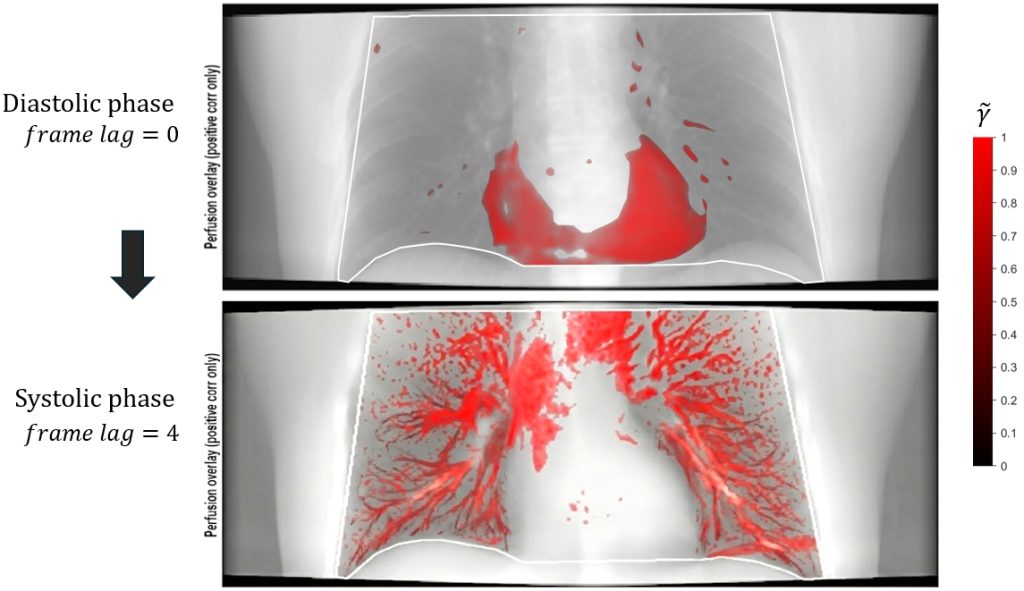
Fig. 4. A dynamic color-coded pulmonary perfusion image. The upper panel presents the perfusion map at the diastolic phase (frame offset FL = 0), where the maximum correlation intensity is located in the cardiac region. The lower panel shows the perfusion map at the systolic phase (frame offset FL = 4), where the maximum correlation intensity shifts to the intrapulmonary vessels.