Lifetime-Driven Multihole Bursting of Oil-in-Water Emulsion Bubbles

Evolution of pure water bubble plumes over time

Background

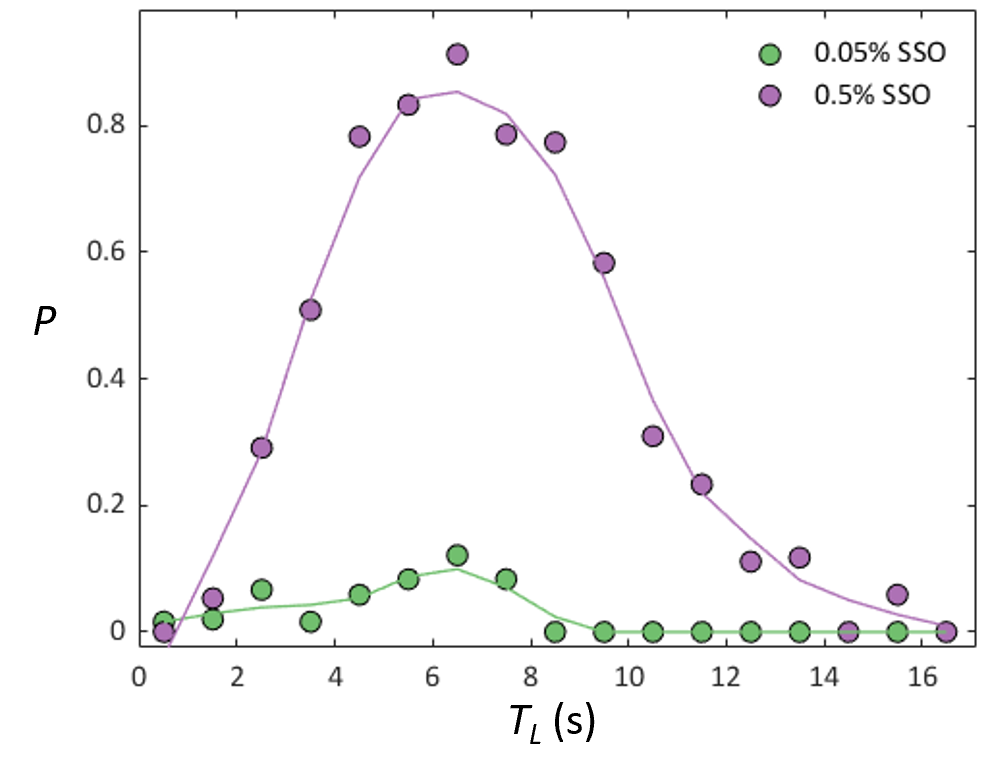
Bursting bubbles at contaminated air–water interfaces can aerosolize oil, microplastics, and microbes, but predicting the resulting drop yield requires linking bubble lifetime (TL) to bursting dynamics. In dilute oil-in-water emulsions, the cap film thins during drainage and ultimately bursts; while hole expansion remains Taylor–Culick-like, lifetime controls the film thickness at bursting and the bursting topology. We show that lifetimes within an intermediate window promote a transition from single-hole to multihole bursting, where near-simultaneous perforations increase active rim length, intensify rim–rim interactions, and substantially boost film-drop production (Nd).

Experiment

To quantify how bubble lifetime controls multihole bursting in dilute oil–in–water emulsions, we performed single-bubble bursting experiments in water and emulsions with controlled oil volume fraction. Bubble caps were imaged with high-speed cinematography to resolve the onset of bursting, hole expansion, and the formation of secondary perforations. For each event, we measured the bubble lifetime, inferred the cap-film thickness at bursting from Taylor–Culick-like hole growth, and recorded the bursting topology (single-hole versus multihole) together with the resulting film-drop production.

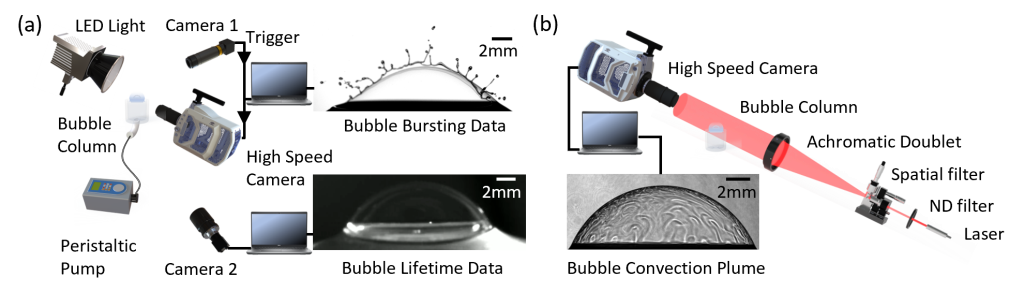
Figure 1. (a) Schematics of high-speed cooperative bubble lifetime and bursting dynamics measurement system. (b) Set-up of the digital inline holography (DIH) for bubble convections plumes visualization.

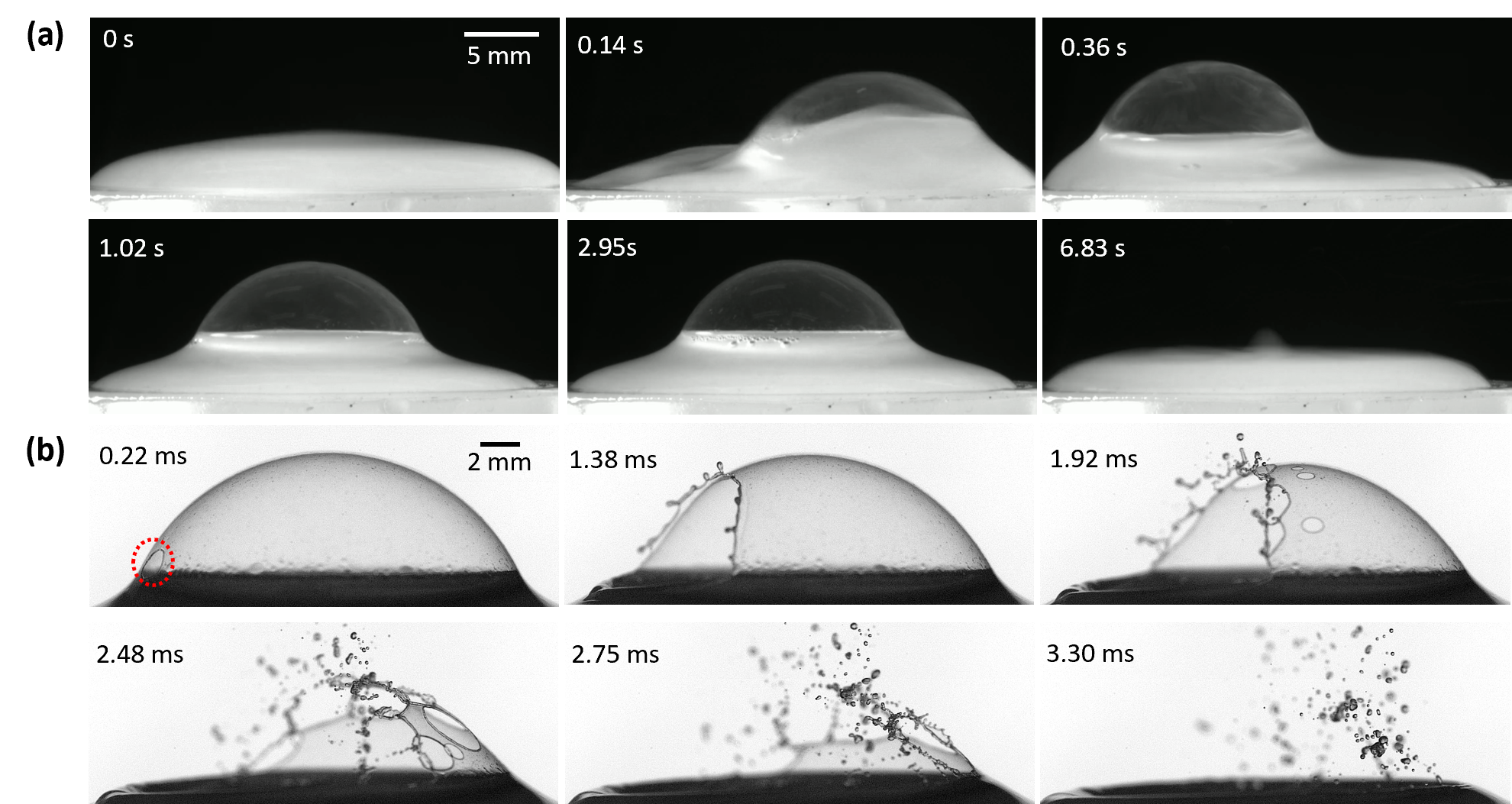
Figure 2. Image sequences illustrating the measurement of (a) bubble lifetime (TL = O(1 s)), and (b) bubble bursting (TB = O(1 ms)). Onset of 1st hole is indicated in (b) by red dashed circles.

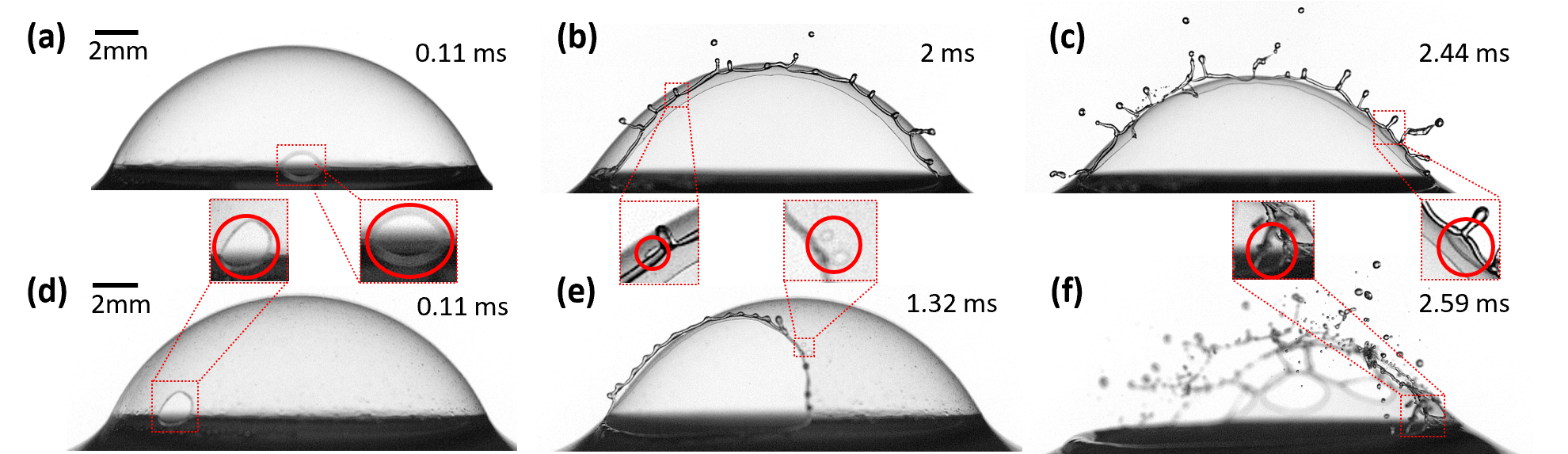
Figure 3. Image sequence illustrating the formation of the (a) 1st, (b) 2nd and (c) 3rd hole of a case at 0.05% concentration, and the formation of the (d) 1st, (e) 2nd and 3rd (simultaneous), and (f) 20th hole of a case at 0.5% concentration, respectively. As reference the time, the creation of the 1st hole is defined as t = 0 s. Holes are indicated by red dashed rectangles (magnified in the insets).

Figure 4. Probability of multi-hole versus bubble lifetime.