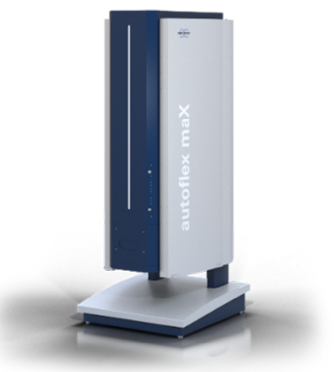
Bruker Autoflex Max LRF Maldi-TOF

The Matrix-Assisted Laser Desorption/Ionization Time-of-Flight (MALDI-TOF) is a powerful mass spectrometer with a rapid, accurate, and high-resolution technique. The MALDI process involves sample molecules crystallising with a matrix compound, which upon laser irradiation, facilitate the generation of ions. The MALDI technology provide a soft ionization for types of molecules or large biomolecules without fragmentation, which can be used for analyzing a wide range of molecules; synthetic small molecules, peptides, proteins, metabolites and polymers; and allowing for accurate molecular mass determination, as well as polydispersity information of polymers. Based on peptide mass fingerprinting (PMF), MS/MS system equipped high-energy CID (Collision-Induced Dissociation) also enable to produce fragmentation spectra to achieve verification of peptide sequences and protein identification. The device can operate in the linear, reflectron or TOF/TOF modes, studying both positive and negative ion species. These make it an extremely flexible analytical tool.

Technical details:

Mass range: Linear mode for large molecules up to 500,000Da

Resolution: 26,000 FWHM achieved in reflectron mode,  1100 FWHM in linear mode

                      3500 FWHM in TOF/TOF mode

Sensitivity: Linear mode:  500 fmol BSA (m/z 66,000)  S/N ≥ 100:1

                     Reflectron mode:  250 amol peptide (m/z 1,570.7)  S/N ≥ 100:1

                     MS/MS mode:  250 amol 1570.68Da(Glu-Fib), fragment 1,056 Da at S/N ≥ 10:1

Mass accuracy: Linear < 100 ppm (external calibration);

                            Reflectron < 10 ppm (external calibration);     2ppm (internal calibration)

Mascot search engine: identify protein from primary peptide sequences

Applications:

  • Organic molecules, peptides, proteins, nucleic acids, lipids and sugars MW determination
  • Proteomics, Peptide mass fingerprinting
  • Protein top-down sequencing (without enzymatic digestion)
  • Polymer characterization
  • Isotopic distribution of transition metals and their complexes

Sample requirements: nonvolatile compounds