

GTIIT Disciplinary Code
In the spirit of the Technion, Israel Institute of Technology, studies at GTIIT are based on trust between the university, represented by the employees and members of the academic staff and the students who are studying therein.
Students are obliged to maintain academic honesty and to conduct themselves in a manner that respects the dignity of GTIIT.
The purpose of this document is to regulate the manner in which cases violating the academic rules should be handled. Non-academic offenses are covered by the Student Code of Conduct published by the GTIIT Student Affairs Office.

1.DEFINING TERMS
The terms specified below will have the adjacent meanings for the purposes of these regulations:
1.1."GTIIT" – Guangdong Technion Israel Institute of Technology, including anybody or institute under the control, the management or the supervision of GTIIT.
1.2."Student" - A person who at the time the offense was committed was one of the following (in the framework of the undergraduate or graduate school, the unit for continuing education and external studies, the pre-academic education center, or any other educational organization managed by GTIIT - excluding an institution that has an independent set of disciplinary regulations):
1.2.1.Someone who has enrolled to study at GTIIT including one w h o is currently undergoing the admissions process and whose application has not been rejected.
1.2.2.A student at GTIIT who is on leave from studies or a student who is on suspension of studies.
1.2.3.Someone who has completed his studies but has not yet been awarded a degree.
1.2.4.Someone who has completed his studies at GTIIT and been granted a degree or certificate, provided that the disciplinary offence for which he is accused or could be accused could lead to the cancellation of the degree and or certificate.
1.3."GTIIT Person" - an academic faculty member, an administrative or technical employee, including any person acting on behalf of it, or a fellow student at GTIIT.
1.4."GTIIT Property" - property belonging to GTIIT, or held or operated by it, including property that is held or is in the possession of GTIIT person including intellectual property.
1.5."Disciplinary Offense" - any act or omission of those specified in the various sections of Chapter 4 below.
1.6."GTIIT Grounds" - all the areas controlled and/or occupied by GTIIT and/or under its management, and/or areas in which GTIIT conducts academic activities, or activities are carried out on its behalf.
1.7."GTIIT Visitor" - any person on the GTIIT grounds who is not a GTIIT person.
1.8.“Subject” or “Course” – a course of study, or research, a project, or final paper for graduate studies, as the case may be.
1.9.“Computer” – as defined in the Chinese Computer Laws, and any update to that law, including smart phones and/or other devices with similar purposes or applications including peripheral devices.
1.10.“Reading room” or “library” (when such exists) - including computerized libraries, video libraries, or data files stored in any manner or on other platforms.
2.GENERAL
2.1.When the wrongdoer is a graduate student or attending a Continuing Education and External Studies unit or attending pre-academic studies the regulations will be adjusted as follows: anywhere that states "the Dean for Undergraduate Studies" should read, respectively, "the Dean of the Graduate School" or "the Head for the Continuing Education and External Studies " or "the Head of the Pre-Academic Education Center".
2.2.A complaint against a student who is a junior academic faculty member (such as a teaching associate or sub-associate teacher or assistant sub-associate teacher), who is charged with an offense primarily associated with his functioning as a faculty member, will be handled as part of the academic staff disciplinary proceedings*. In the event of a dispute with respect to the framework for handling such a complaint, the dispute will be remitted to the Vice Chancellor (hereinafter referred to “VC”) whose decision regarding the matter will be final unless he finds it appropriate to bring it to the VC for further discussion.
2.3.The disciplinary committee (see Clause 5.7) will act to the best of its understanding to ensure the possibility of investigating the matter of concern, pursuing justice, preserving natural rules of justice and preventing disproportionate harm to the accused rights. In order to achieve these goals, the disciplinary committee has the right to correct any defect or mistake in any proceeding, and to give instructions in any other matter as it deems to be just.
2.4.The submission of a complaint will be regarded as the opening of a disciplinary procedure and from that time forward, no other GTIIT person, in the GTIIT framework, will undertake procedures concerned with the matter of the complaint, nor will he, within the GTIIT framework, undertake any means of punishment.
The above does not detract from any right of GTIIT, or of a GTIIT person, to undertake any legal procedure outside GTIIT.
3.DISCIPLINARY RULES
Students must abide by the following disciplinary rules:
3.1.To heed rules of honesty, fairness and ethics applicable to all academic activity.
3.2.To faithfully fulfill all the academic and other obligations applicable to students pursuant to GTIIT regulations and procedures.
3.3.To maintain the honor of GTIIT and its institutions, the honor of its academic, technical and administrative staff, and the honor of its student population, and to
behave appropriately.
3.4.To observe the instructions of GTIIT people while they are carrying out their duties.
3.5.To preserve GTIIT property, to maintain cleanliness and order on GTIIT’s grounds.
In order to enforce these principles an academic disciplinary judicial system will be operated as set forth below.

4.DISCIPLINARY OFFENSES
A student has committed a disciplinary offense if he did one of the following:
4.1.Breached a study obligation assigned to him by GTIIT, including:
4.1.1.Committing, by cheating or some other illegitimate means, an act in order to improve a grade in an exam, test or quiz, assignment, project, practical work or any other study task, or in order to achieve an academic advantage for himself or for another student.
4.1.2.Having in his possession prohibited study materials or equipment during an exam or test, whether he used it during the exam or test or not.
4.1.3.Copying from another student, or knowingly allowing another student to copy from him, in an exam, a test, assignment, project or any other study task.
4.1.4.Helping another student, in some other way, or being helped by another student, during an exam or test or while completing another study task for which the student is required to do independent work.
4.1.5.Conspiring or participating in a conspiracy, in order to attempt to commit any of the offenses mentioned in this section.
4.2.Did not obey an instruction given by a GTIIT person who was fulfilling his role or refused to identify himself to the GTIIT person who was fulfilling his role.
4.3.Damaged, or knowingly caused damage in any way, to the GTIIT’s honor and/or the dignity of a GTIIT person or that of a GTIIT visitor in their status as GTIIT persons or visitors.
4.4.Participated in a fight, behaved violently, attacked or injured a GTIIT person or a GTIIT guest or assaulted a GTIIT person or a GTIIT visitor while on GTIIT grounds, or while on GTIIT duty, even if outside the GTIIT grounds.
4.5.Disrupted or interfered with teaching, research or work at the GTIIT or any other academic activity being conducted on the GTIIT grounds.
4.6.Performed an act that constituted sexual harassment or abuse, as defined in the GTIIT’s policy regarding the prevention of sexual harassment as enacted from time to time, and/or breached GTIIT policy for the prevention of sexual harassment in any other way. The disciplinary procedure for handling such an offense will be pursuant to the GTIIT policy for Sexual Assault Prevention & Response published by the HR Department, as far as it contains other or extra instructions.
4.7.Performed an act that constituted fraud, deceit, forgery or providing false information, in any matter directly or indirectly concerning the obligations or
rights of a GTIIT student, whether his own or those of another student.
4.8.Obstructed, by an act or by omission, a disciplinary proceeding, including: perjury, tampering with evidence, destroying evidence, refusing to testify despite being called by the disciplinary committee (unless a reasoned application was received pertaining to his refusing to testify due to a familial relationship or due to special circumstance as determined by the court), or did something (or refrained from doing something) deliberately to obstruct the disciplinary proceeding and/or to bring about an injustice - whether by concealing evidence, preventing a witness from testifying, harassing a witness, causing a witness to commit perjury, or in any other manner.
4.9.Impersonated, by computer use or by any other means, another GTIIT person, or presented himself to a GTIIT person as if he was someone else.
4.10.Offenses associate with the library, books and publications.
4.10.1.Committing an act that harms the right of others to use a book, publication, files or any other material belonging to the GTIIT library or managed by them or accessible via them (including all material borrowed from other universities using GTIIT library services), or disruption of the usual regular operations of the library in contradiction to the regulations or GTIIT library procedures, including but not limited to removal without permission or not returning a book, or mutilating or removing pages from a book.
4.10.2.Committing an act that infringes on the copyright of material stored in the library, including unauthorized copying (whether by photocopying or whether copying by computer or by any other means) including unauthorized transfer to another person.
4.11.Offenses related to the computer
In this section “authorization” means receiving explicit personal permission from the GTIIT IT division systems or from the manager of a certain GTIIT computer network or from anyone certified to give such authorization.
4.11.1.Unauthorized or illegal access to the GTIIT computer, to a computer used by a GTIIT person, to the GTIIT internet sites, to a GTIIT person’s email, whether by use of a password which was not authorized at all, or not authorized for the purpose of the access, or whether by any other means.
4.11.2.Unauthorized or illegal access via the GTIIT computer, the GTIIT network, or a computer used by a GTIIT person, to another computer, internet site, email account, or specific files.
4.11.3.Caused damage, deletion, made changes or any other actions on files or computer instructions, or in software, maliciously or knowingly, during authorized or unauthorized use.
4.11.4.Performed an act with a GTIIT computer for personal use or for purposes other than the GTIIT’s, including but not only, copying software, sharing files whether the use was for profit or for any purpose other than that for which authorization was given. In this respect, any unauthorized use of a computer will be considered use for personal needs. Despite the above, reasonable and acceptable use of a GTIIT computer, for reasonable and acceptable private uses of a user, which are not commercial uses, such as sending email, surfing on the internet etc., of themselves will not be considered as disciplinary

offenses, according to this sub-section, as long as they do not constitute a breach of another instruction.
4.11.5.Infringed copyright by using a GTIIT computer or infringing the copyright of a work that was delivered for use on GTIIT computers or to which access was given, for student use, including illegally downloading or distributing files or software or work.
4.11.6.Made use of information, or remitted information, that was obtained without authorization in one of the ways listed above.
4.11.7.Remitted an access password, which was given to him only for his own personal use, to another person, without obtaining explicit authorization, or allowed unauthorized use of it. The remitter of such an access code will be considered an accessory to any offense that the receiver of the password committed by accessing the computer using the password, unless the disciplinary committee determines otherwise.
4.11.8.Distributed over the internet or via electronic mail material that is slanderous, racist, inciting, or obscene, provided that the distribution is over GTIIT’s network, on GTIIT’s and its units’ websites, or through use of GTIIT equipment, or in any other manner associated directly or indirectly to the GTIIT computer network.
4.11.9.Took part, initiated, participated or attacked computer systems in GTIIT, of GTIIT or of a GTIIT person, or took part, initiated, participated or carried out an attack using a GTIIT computer or the GTIIT network, even if it was not carried out against GTIIT.
4.11.10.Infringed on the instructions of the Computer Law, using a GTIIT computer or a GTIIT person’s computer, or in so doing it was possible in view of the circumstances to identify him as a GTIIT student.
4.12.Contravened any of the conditions to receive a scholarship without the approval of the Dean of the Undergraduate or Graduate Studies or alternative authority, as may be relevant, including taking on extra work in outside GTIIT, in contradiction to the conditions for receiving a scholarship.
4.13.Was convicted of a criminal offense with a final verdict pertaining to an act or omission that is related to his being a GTIIT student, or that the said conviction brings dishonor to GTIIT or to any of its people or consists of behavior inappropriate to that of a GTIIT student.
4.14.Behaved in a manner inappropriate for a GTIIT student concerning an action connected with the GTIIT or related to being a GTIIT student.
4.15.Breached an assigned undertaking related to his professional training in which he takes part as a student, including medical or other confidentiality or secrecy requirements.
5.CHARGING PROCEDURES
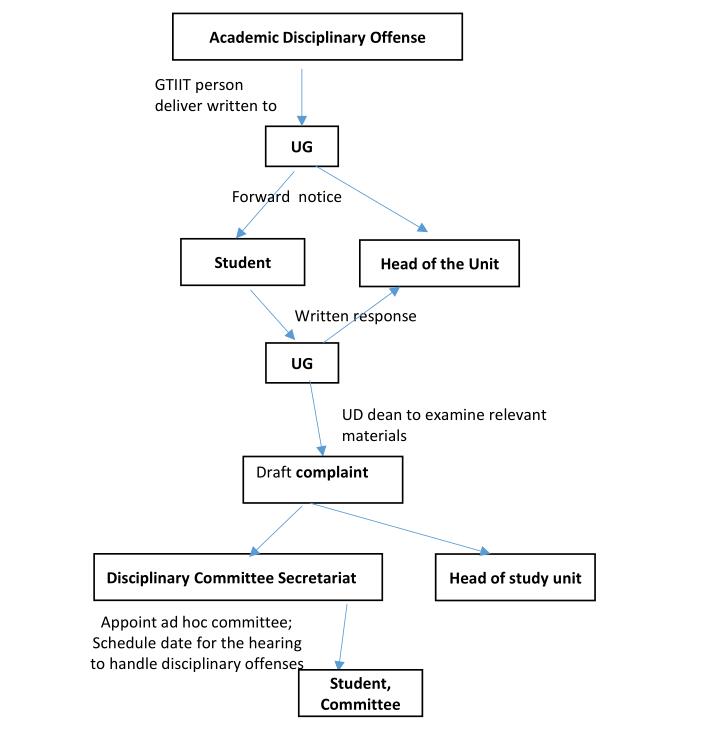
5.1.A GTIIT Person who became aware of the commission of an academic disciplinary offense by a student may deliver to the Discipline Unit affiliated to the Undergraduate Studies Office a notice in connection therewith.
5.2.In case the Discipline Unit received a notice as aforesaid, it shall forward the said notice to the student, as he deems fit, and will request from the student to receive his written response within a definite period, ordinarily up to 14 days. The Discipline Unit shall inform the student regarding the provisions set forth in these Disciplinary Regulations and shall inform the student that he is entitled to consult with any GTIIT Person prior to presenting his response.
The aforesaid shall not derogate from the powers of the Discipline Unit to conduct additional inquiries and inspections prior to delivering the notice to the student or thereafter and even delay a notice to the student to the extent that he is of the opinion that it is necessary to exhaust different preliminary inspections.
5.3.A representative from the UG office shall examine the relevant materials within a reasonable time and shall be entitled to decide to press charges against the suspicious student or cancel the complaint. In case the representative decides to press charges, he/she will draft a complaint that will include the details of the offense including:
(a) the facts alleged against the defendant, including also the time and place of commission of the argued offense. (b) The section in this document that served as grounds for the filing of the complaint. (c) The names of the witnesses he/she intends to summon to testify. (d) A recommendation to the disciplinary committee according to the nature and severity of the offense.
No documents or evidence shall be enclosed with the complaint.
5.4.The statement of complaint shall be delivered to the disciplinary committee secretariat after a decision to serve the complaint was made.
5.5.The Discipline Unit shall serve to the defendant student, by the disciplinary committee secretariat, the statement of complaint shortly after its submission and shall notify the student that he is entitled to peruse all the documents that are held by the prosecution and copy them and shall inform the student regarding his right to receive assistance from any GTIIT Person for the purpose of handling the proceeding.
5.6.A copy of the statement of complaint shall be delivered to the head of the academic unit in which the student is enrolled and to the head of the unit to which the complainant belongs.
5.7.The chairman of the disciplinary committee (typically the UG or Graduate Dean) will determine the composition of the committee and the UG secretariat will coordinate and schedule a date for the hearing and will inform all relevant parties about it.
5.8.A decision on the filing of a complaint more than a year after commission of the offense shall require the approval of the VC.
5.9.Limitation – without derogating from the foregoing, a student will not be prosecuted for disciplinary violations if three years passed from the date the offense was committed and the complaint was filed.
Notwithstanding the aforesaid, the limitation shall not apply when the punishment for the offense for which the student is accused might prevent issuance of a certificate of graduation or a certificate of completion or a degree or might result in their retroactive revocation.
5.10.One complaint may be filed against a number of defendants if each of them was a
party to the offenses described in the complaint or any thereof, whether as an accomplice and whether in any other manner, or whether the indictment is for a series of acts that are related to each other to such degree that they constitute one offense. Failure to add one party to an offense shall not constitute preclusion to prosecute another. The committee may, at any stage prior to delivering the verdict, instruct the separation of the trial of a certain defendant that was accused with others.
5.11.The disciplinary committee shall ordinarily handle disciplinary offenses without derogating from the powers of the teacher to handle, after conducting an inquiry with the student, the inappropriate behavior of the student in person as part of their teacher/student relationship.
A student who feels aggrieved by the manner the teacher handled his case may request a hearing by the disciplinary committee for the acts attributed to him by delivery of written notice to the Discipline Unit in 30 days as of the date the teacher informed him about his decision. In case the student delivered such notice as aforesaid, the decision of the teacher will be suspected and the Discipline Unit willact as if a complaint was submitted to him and the GTIIT shall not conduct any additional proceedings regarding the subject matter of his request. In any event, no punishment may be inflicted on the student by GTIIT or by any other entity except for the disciplinary committee if and to the extent that the student is convicted.
6.THE DISCIPLINARY COMMITTEE
The ad-hoc disciplinary committee will be appointed by the Dean of Undergraduate (or Graduate) Studies.
The Discipline Unit will be responsible for managing the administrative aspects of the disciplinary procedure and will appoint an ad hoc secretary to the committee who will assist with the administrative matters related to the committee’s activities.
7.PUNISHMENT OPTIONS
7.1Disciplinary punishments are as follows:
a. Warning (with or without changes of the grade) + conditional suspension for one semester on next violation of a similar nature detailed in section 4.1; b. Grave warning (with a zero grade in one or more courses) + conditional suspension for one semester on next violation of a similar nature detailed in section 4.1; c. Suspension of studies of minimum of one semester and up to a one-year period; d. Expulsion from school.
7.2.A student may be expelled from studies by the school upon realization of any of the circumstances detailed in Decree 41 of the PRC Ministry of Education, Article 52.
7.3.While within the period in which the punishment holds, students cannot participate in the assessment of various scholarships and honorary titles. After the punishment is lifted or terminated, students receiving recognition, awards and other benefits are no longer affected by the original decision.
8.APPEALS
A student submitting an appeal shall, within 10 days from the date of receipt of the school's disciplinary decision, submit a written application of a “Student Appeal” to the VC Office, a copy of the Disciplinary Committee decision, and relevant evidential materials. The VC shall decide on the appeal within 15 working days. If the situation is complex and conclusions cannot be reached within the prescribed time limit, the period may be extended for another 15 days with the approval of the VC.

Appendix A
PRC MOE Decree 41, translation of Article 52: A student may be expelled from school by the school as any of the following circumstances:
(1)Violating the Constitution, being against the Four Cardinal Principles, disrupting stability and unity or the social order;
(2)Violating the state laws and constituting a crime;
(3)Being punished by public security provisions due to a serious and evil violation;
(4)Replacing or asking another to take an examination, arranging for the cheat, cheating by using communication equipment, benefiting from selling the examination papers or answers, and practicing a grave fraud in any other form or disrupting the examination order;
(5)His academic dissertations or published research results are found to have such academic misbehaviors as copy, tamper, fake, etc. and the circumstances are serious; or he replaces another to write the dissertation or sells the dissertation;
(6)Violating these provisions and the provisions prescribed by the school, seriously influencing the educational and teaching order and living order of the school and the management order of a public place;
(7)Impairing the legitimate rights and interests of any other individual or organization, and thus causing a serious outcome; or
(8)Frequently violating the provisions prescribed by the school and being given disciplinary sanctions, but failing to make corrections upon education.
Appendix B
Laws regarding computer information and network security in China:
(1)General legal provisions such as the Constitution, State Secrets Law, Copyright Law, Patent Law, etc. The objects they regulate include the activities that harm the information network security.
(2)Laws governing and punishing cybercrime such as Criminal Law.
(3)Special provisions for the direct protection of computer information networks, such as PRC Computer Information System Security Protection Regulations and PRC Computer Information Network Interconnection Provisional Regulations.
(4)Specifications of information network security technologies and management, etc. such as Interim Regulations on the Confidentiality Management of Computer Information Systems and Administrative Regulations on Electronic Publications, etc.
【202100808】GTIIT Disciplinary Code.docx


Follow us

 GUANGDONG TECHNION-ISRAEL INSTITUTE OF TECHNOLOGY